


4 products
4 products


|
Blues Cell+WiFi Kits contain everything you need to start building cloud-connected IoT solutions with Notecard and Notehub. Choose the kit that matches your workflow — whether you want an all-in-one development setup, prefer to bring your own host microcontroller, or need a compact, solution-ready module. All kits include a “Midband” Notecard Cell+WiFi — a secure, low-power IoT system-on-module combining global LTE Cat-1 bis Cellular+WiFi and 2.4 GHz WiFi in a single 30mm × 42mm device. With just two lines of code, you can send data to the cloud in minutes. No complex device registration or provisioning required. |
Kit Options
Blues Solution Kit for Cell+WiFi - $79
New to Blues? This is the kit we recommend most new users start with.
Built around Notecarrier CX, the first Notecarrier with an onboard Host MCU, this compact kit provides a low-cost way to kickstart your prototype, and take you to pilot and beyond.
Kit Contents:
-
Notecard Cell+WiFi LTE Cat-1 bis Global
-
Notecarrier CX with onboard STM32 MCU
-
Flexible dual Cellular and GPS antenna
Blues Starter Kit for Cell+WiFi - $74
This kit is designed for developers who already have a preferred host microcontroller or single-board computer, and it's the most affordable way to add global Cell+WiFi connectivity to your existing hardware.
Note: With this kit you’re responsible for wiring your host to the provided Notecarrier X. If your host has a Qwiic port you can connect via a Qwiic cable; otherwise, you’ll need to solder headers onto the Notecarrier X and wire it yourself with jumper cables. See our Host Wiring Guide for details.
Kit Contents:
-
Notecard Cell+WiFi LTE Cat-1 bis Global
-
Notecarrier X
-
Flexible dual Cellular and GPS antenna
Blues Feather Kit for Cell+WiFi - $99
Blues Feather Kit for Cell+WiFi contains everything you need to prototype and build connected solutions on the popular Adafruit Feather form factor. Start with Cygnet (a Feather-compatible STM32-based host MCU), slot it into Notecarrier F (the Blues development board designed for Feather hosts), and pair it with a Notecard Cell+WiFi (MB) to start sending data to Notehub in minutes.
Kit Contents:
-
Notecard Cell+WiFi LTE Cat-1 bis Global
-
Notecarrier F
-
Cygnet
-
Flexible dual Cellular and GPS antenna
Which Kit Is Right for Me?
|
|
Blues Solution Kit |
Blues Starter Kit |
Blues Feather Kit |
|---|---|---|---|
|
Price |
$79 |
$74 |
$99 |
|
Host MCU Included |
✅ STM32L433 MCU on CX |
❌ Bring your own |
✅ Cygnet |
|
Carrier Board |
Notecarrier CX |
Notecarrier X |
Notecarrier F |
|
Best For |
Compact, production-ready builds |
Integrating with your existing hardware |
Rapid prototyping with Feather ecosystem |
|
Recommended Accessories |
Notecard for Skylo, SWD Programmer & Debugger, Mojo, LiPo Battery |
Notecard for Skylo, SWD Programmer & Debugger, Mojo, LiPo Battery |
Notecard for Skylo, Swan, SWD Programmer & Debugger, Mojo, LiPo Battery |
Additional Resources
About Notehub
Notecard is designed to work with Notehub — Blues' cloud orchestration layer for securely routing device data to AWS, Azure, Google Cloud, and other third-party services. Notehub handles secure device connectivity, fleet management, and over-the-air firmware updates with no infrastructure to manage.


|
The Starnote for Iridium Starter Kit contains everything you need to add global, pole-to-pole satellite failover to any cellular or WiFi Notecard-based solution. Powered by Iridium's Low Earth Orbit (LEO) constellation, Starnote for Iridium delivers coverage anywhere on the planet, including open ocean and the most remote locations where terrestrial and regional satellite networks can't reach. Starnote for Iridium bundles 10KB of satellite uplink and downlink data into the cost of the device itself. When your application needs to fall back to satellite, it's ready — no activation required, no recurring cost. Starnote for Iridium is designed to challenge the assumption that global satellite connectivity demands expensive hardware and mandatory monthly fees, even when devices aren't actively transmitting. |
As an accessory, Starnote for Iridium is not a Notecard; it is meant to be used with Notecard, and works with Notecard Cellular and Notecard Cell+WiFi. From a developer’s point of view, Starnote for Iridium operates as an additional available radio access technology (RAT) for Notecard. Use the same JSON API to specify when Notecard should fallback to Satellite, and Notecard handles communications between itself and Starnote for Iridium.
Notecarrier XI is the companion Notecarrier to Starnote for Iridium and Notecard, providing a platform for prototyping with Satellite failover. Notecarrier XI includes two M.2 Key E connector sockets and internal connectivity for Notecard to Starnote communication. Notecarrier XI also includes JST connectors for solar, LiPo battery and charging support, as well as Qwiic ports for connecting Notecard to host MCUs over I2C.
Kit Contents
-
1x Starnote for Iridium
-
1x Notecard Cell+WiFi (LTE Cat 1 bis | Global)
-
1x Notecarrier XI
-
1x Iridium Helical Satellite Antenna
-
1x 5000 mAh LiPo battery
Key Starnote for Iridium Specs
-
JSON-based API for configuration and communication with Notecard
-
M.2 Key E connector for board-to-board usage
-
On-board u.Fl connector for attaching the included, pre-certified Iridium helical antenna
-
NTN-capable satellite modem with zero-touch configuration
-
Bundled with 10KB of satellite data from Iridium, enough to send 1 message per day for 6 months. Additional data is priced $0.00075/byte, with a minimum of 10 bytes per transmitted or received satellite data packet, billed monthly in arrears.
Key Notecarrier XI Specs
- Notecard M.2 Key E connector socket and mounting screw receptacle.
- Starnote M.2 Key E connector socket and mounting screw receptacle.
-
USB-C port to power Notecarrier and provide a USB Serial command interface to Notecard.
-
External Nano-SIM slot for use of an optional secondary SIM.
-
2-Pin JST PH connectors for solar, LiPo battery power and charging support.
-
1 Qwiic/StemmaQT I2C port for attaching external peripherals.
-
On-board cellular antenna from Ignion
Additional Resources


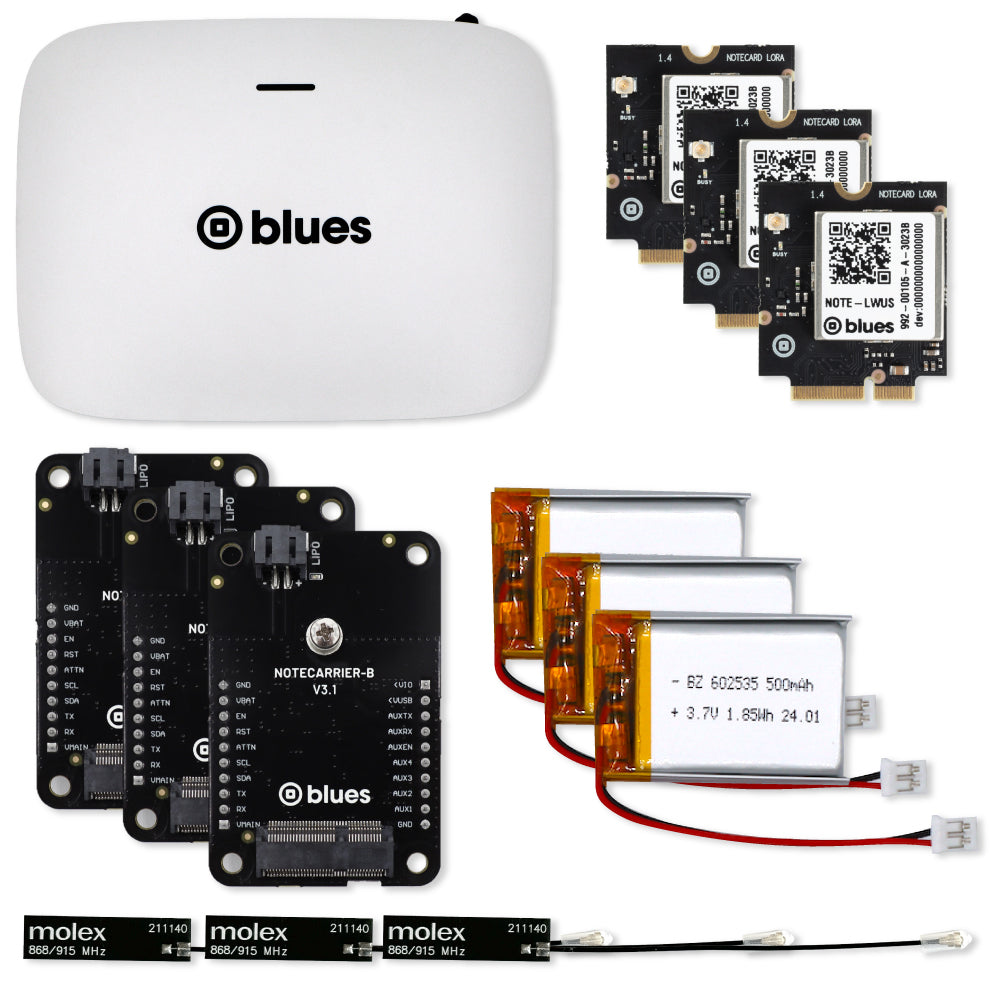
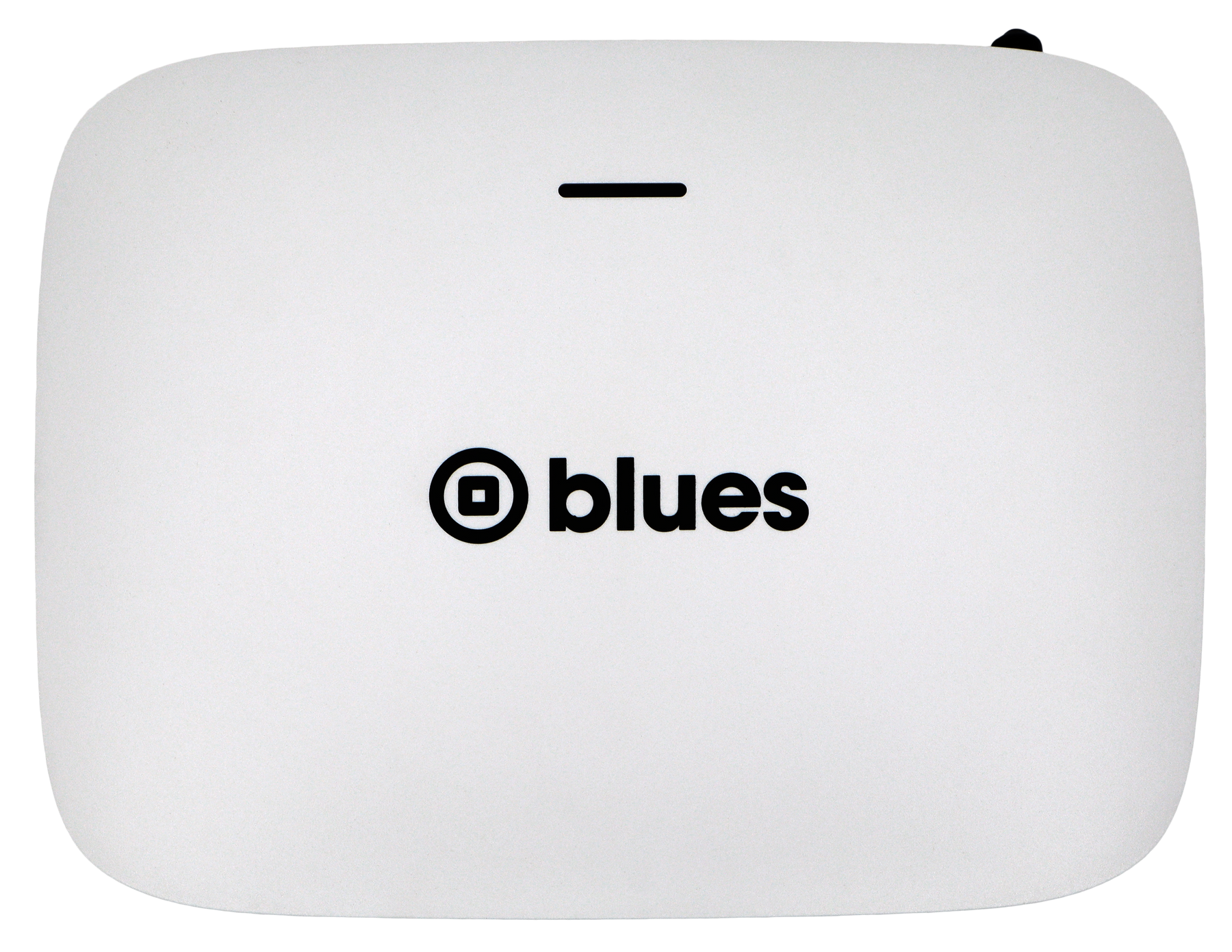
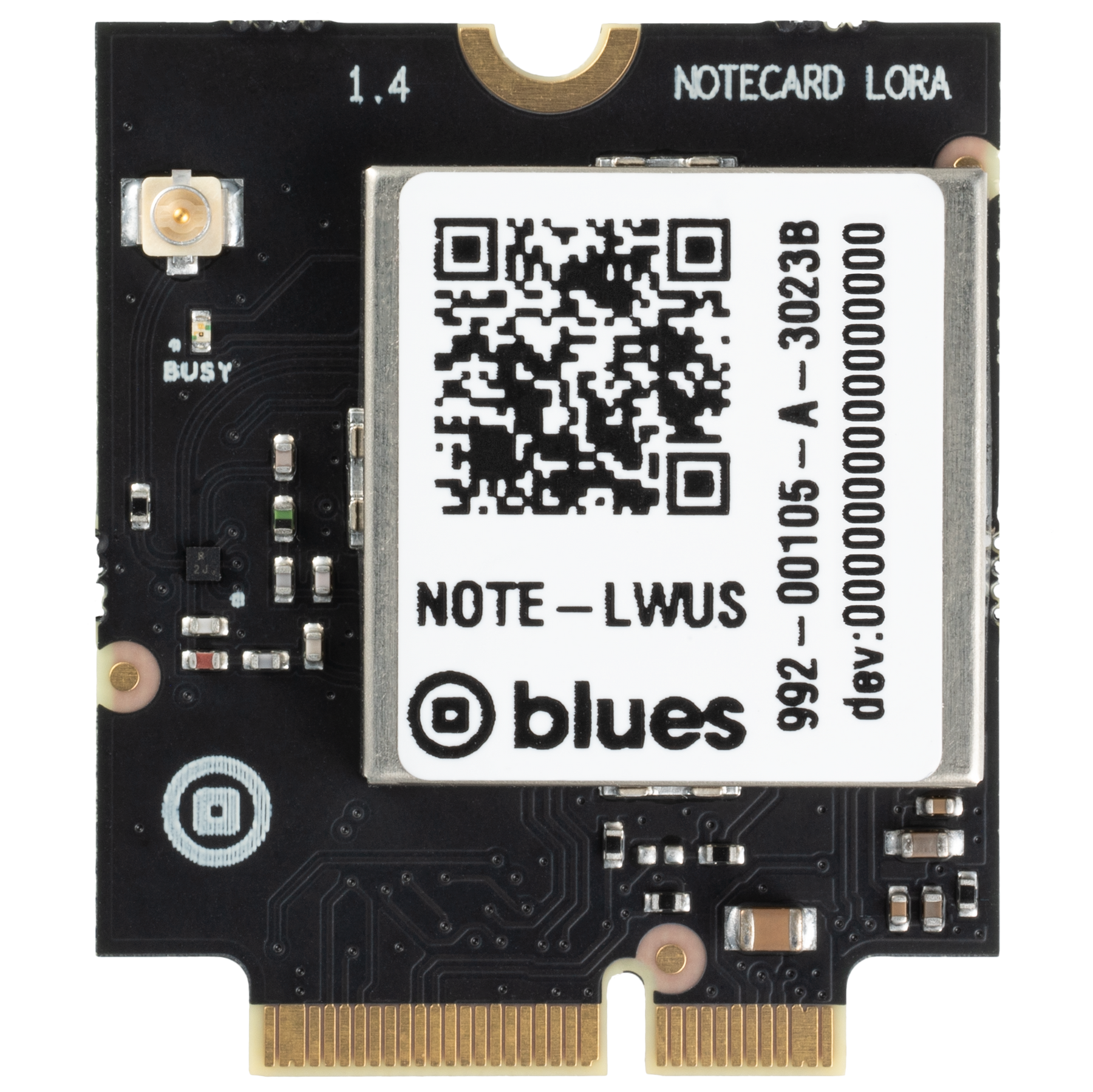
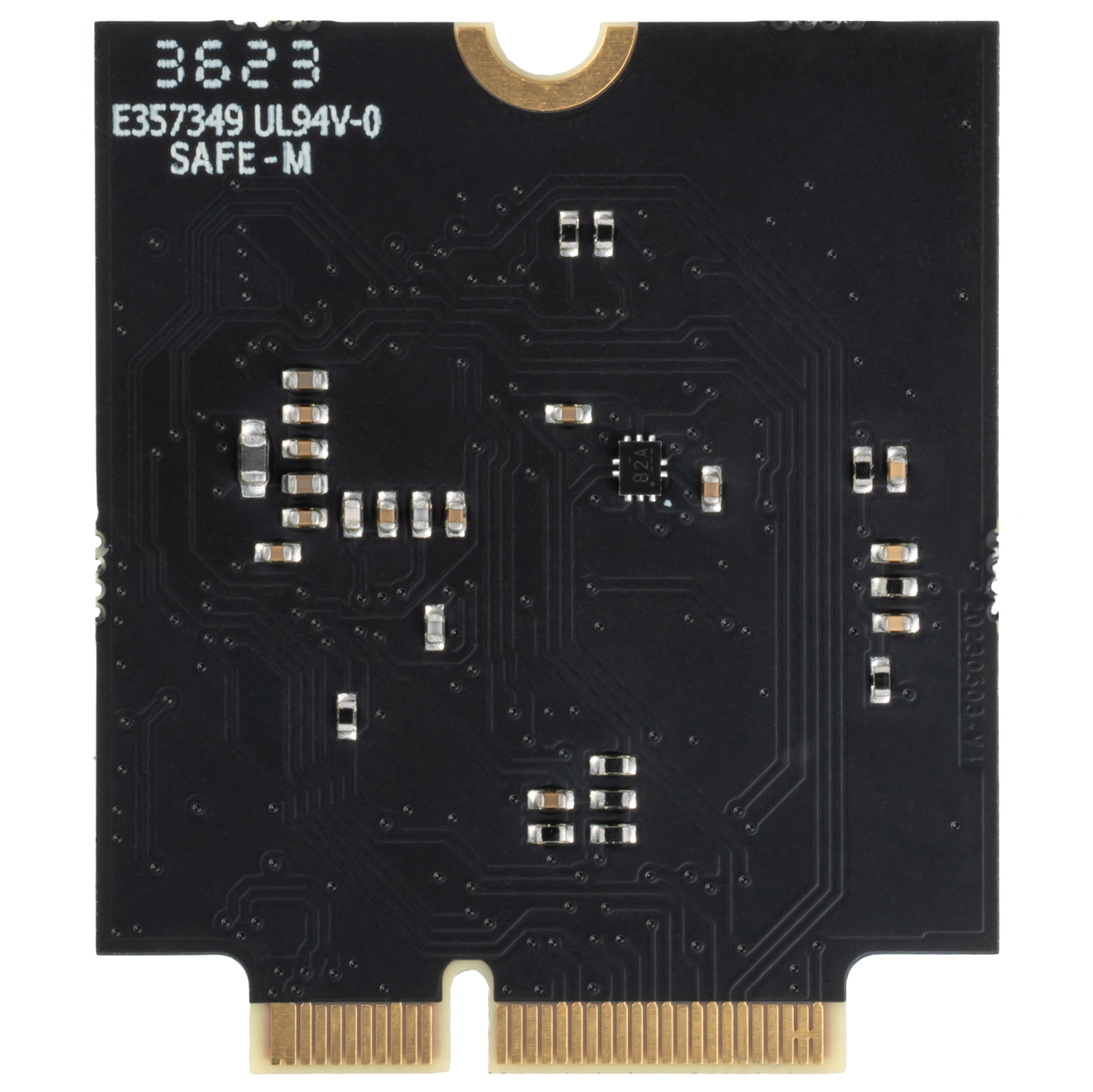
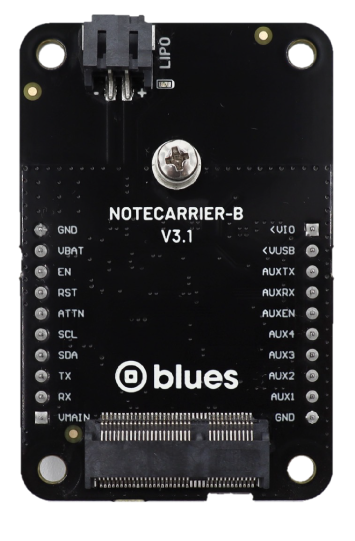
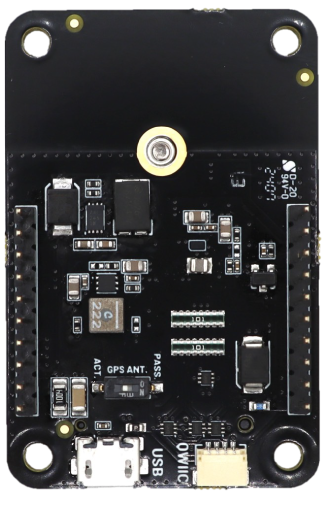
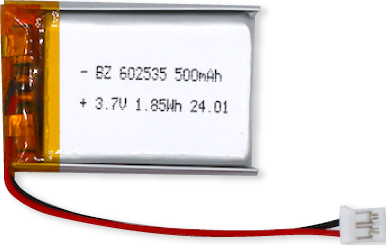

The Blues Starter Kit for LoRaWAN contains everything you need to start building LoRa and LoRaWAN solutions with Notecard and Notehub. Start with a WisGate Edge Lite 2 LoRaWAN Gateway (pre-configured on the Blues Things Stack tenant for out-of-the-box connectivity) and connect it to local WiFi or Ethernet. Then, connect the three included Notecard LoRa devices to the included Notecarriers, place a LoRa antenna on each, and power them up with a LiPo battery. Use the Notecard API to configure the devices, and within minutes, you’ll have LoRa devices talking to Notehub!
Kit Contents
- WisGate Edge Lite 2 LoRaWAN Gateway
- 3x Notecard LoRa
- 3x Notecarrier B
- 3x LiPo Battery
- 3x LoRa Antenna
Key Notecard LoRa Specs
- Onboard ultra-low-power STM32WL LoRa MCU.
-
Compatible with LoRaWAN and The Things Network.
Notecard for LoRa is a lower-cost version of cellular-based Notecards for LoRa only, and is API-compatible with cellular- and WiFi-based Notecards (with some exceptions). Notecard LoRa works with gateways provisioned on The Things Stack. Included is a flexible Molex 211140 antenna that supports both 868 MHz (Europe) and 915 MHz (United States) frequencies.
With just two lines of code, you can send data to the cloud in minutes, no complex device registration or provisioning required. With a powerful JSON-based API, you can program Notecard over USB, or control it from your preferred microcontroller or single-board computer using one of our open-source firmware libraries. Connect from your preferred host to Notecard using Serial or I2C.
Notecard is designed to work with a cloud service for ingesting and processing device data. Notehub provides secure device connectivity, project and fleet management, and simple routing to third-party cloud services.
Available Variants
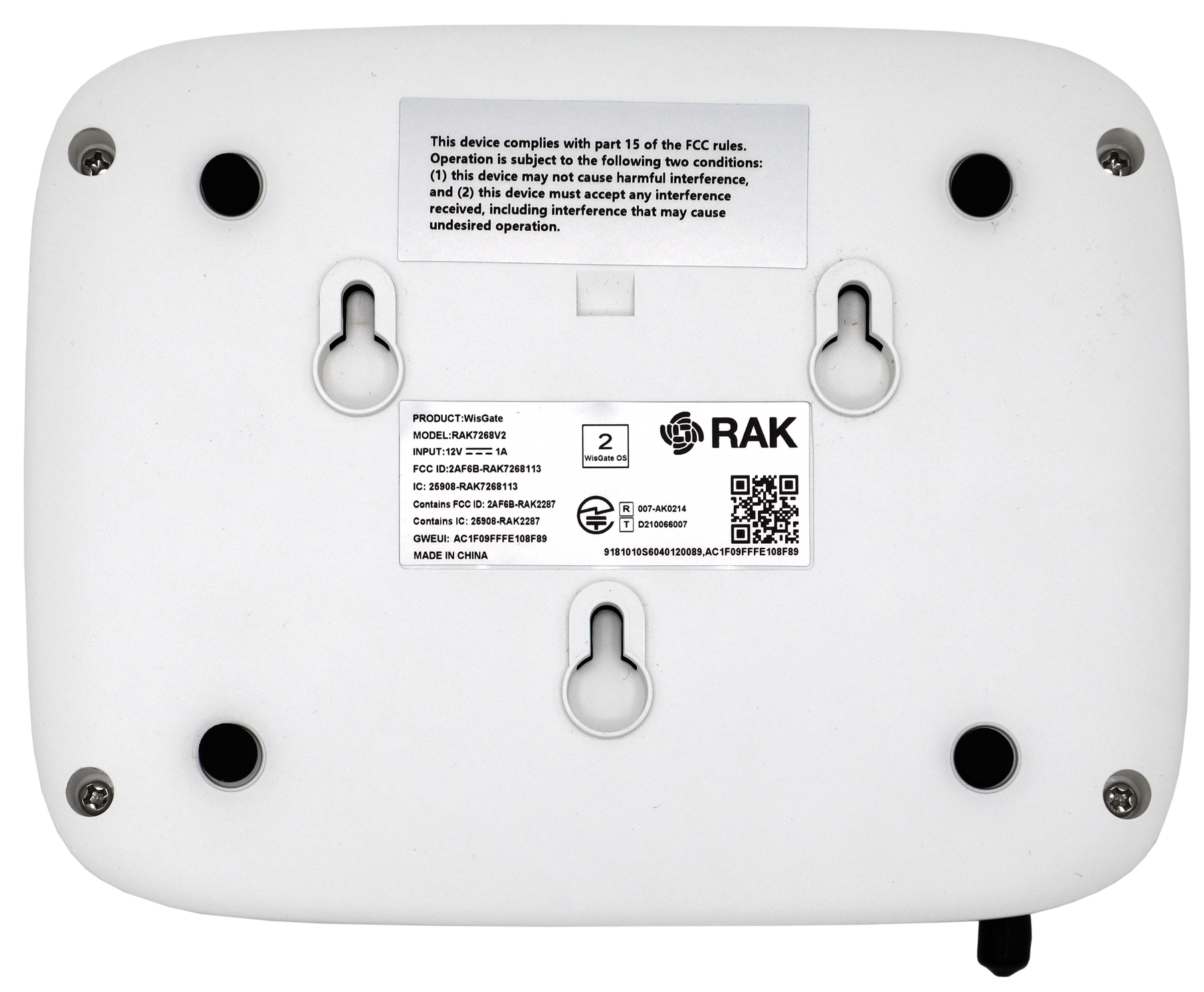
The Blues WisGate Edge Lite 2 is a full 8-channel indoor gateway with full LoRaWAN Stack Support (v1.0.3), Built-in Ethernet and WiFi connectivity. The gateways are pre-provisioned on the Blues Things Stack Tenant to enable out-of-the-box connectivity for Notecard LoRa. See the Blues WisGate Edge Lite 2 product page or RAKWireless documentation for additional details.
Notecarrier B is a small form-factor Notecarrier, only slightly larger than Notecard itself. Unlike other Notecarriers, Notecarrier B does not include an external SIM slot. It includes a Qwiic port for connecting I2C peripherals.
The flexible LoRa antenna has a supported frequency range of 868-870 MHz and 902-928 MHz with a u.FL terminator.
Additional Resources